I2DGS: Physically-Based Inverse Rendering with 2D Gaussian Representations
Report: i2DGS — Inverse 2D Gaussian Splatting for OLAT
Technical University of Munich ·
Supervisor Prof. Matthias Nießner
TL;DR
- Problem
- Relightable 3D assets need geometry and spatially varying materials (albedo, roughness, metalness), but radiance-field methods such as NeRF and 3DGS entangle lighting, material and geometry.
- Approach
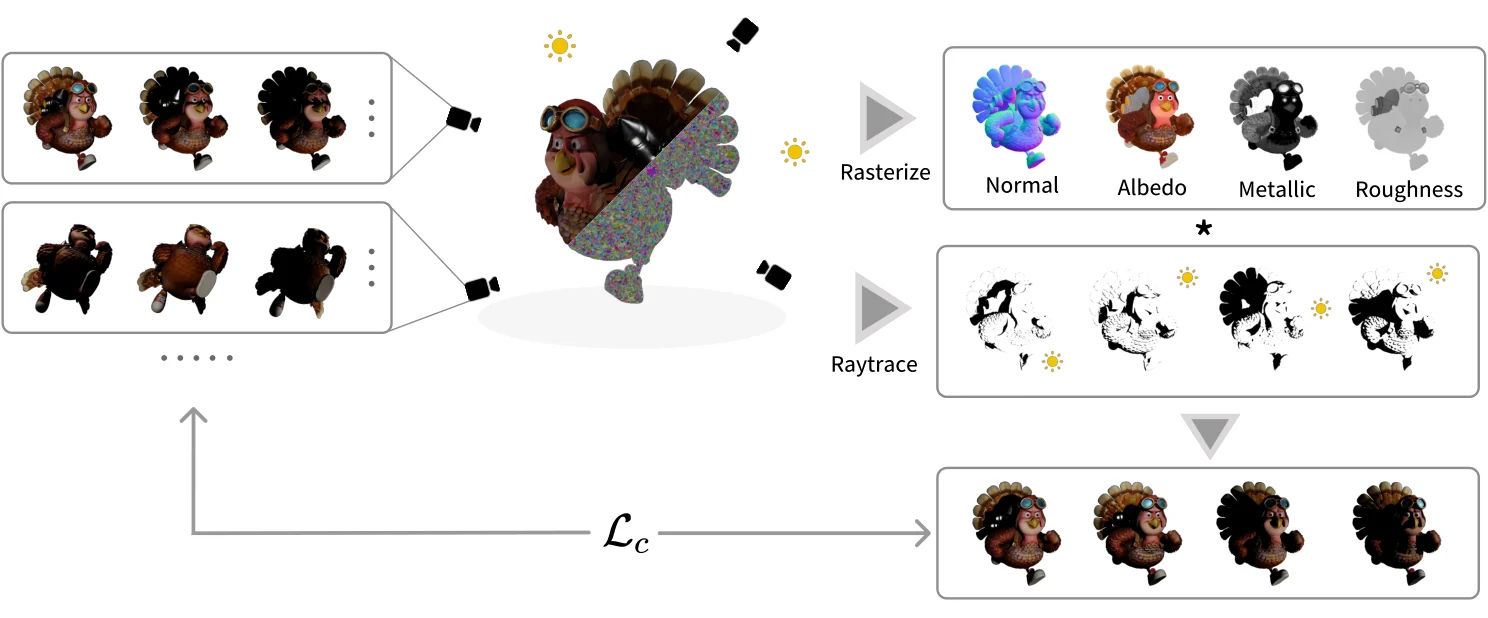
- A two-stage pipeline under one-light-at-a-time (OLAT) supervision: 2D Gaussian Splatting first recovers geometry under uniform lighting; then spherical harmonics are replaced by per-surfel PBR attributes, rendered with deferred Disney-style shading, and shadows come from a differentiable, BVH-accelerated ray tracer over the surfels.
- Contribution
- A fully differentiable 2DGS + PBR inverse-rendering pipeline with ray-traced shadows. On four synthetic OLAT objects it reaches 32.8–35.7 dB relighting PSNR, higher than RNG and GS³ on every object.